Employee Generated Content, or EGC for short, is content created by, or featuring, real employees talking about their work, their team, their culture, or their expertise. It can live on employees’ personal channels, on company channels, or on both. The defining feature is simple: the employee is the messenger.
That shift, from brand voice to employee voice, is what makes EGC one of the most trusted content formats in Employer Branding today. Candidates have spent years learning to filter out traditional corporate messaging. Seeing and hearing from a potential future colleague instead creates a different kind of trust.
Employee Generated Content is essentially your brand story told by the people who live it every day.
EGC sits at the intersection of Employer Branding, Social Recruiting, and internal communications. It is the Employer Marketing equivalent of User Generated Content (UGC) in consumer marketing.
Why does EGC matter for Employer Branding?
Candidates trust employees more than they trust employer brands. According to the Edelman Trust Barometer, employees are consistently seen as more credible than CEOs or official company channels when communicating about a company. It follows the same principle Nielsen has measured in consumer marketing: in its 2021 study of 40,000 consumers, 88% said they trust recommendations from people they know more than other forms of marketing.
EGC matters because the modern candidate journey is increasingly research-heavy.
Before a TA Specialist ever speaks to a candidate, they have often:
- Searched for the company on Google and LinkedIn
- Watched short-form videos from current employees on TikTok or Instagram
- Read reviews and discussions on Glassdoor and Reddit
- Asked an AI assistant such as ChatGPT, Perplexity, Gemini, or Claude about the company
EGC is Employer Brand content that can naturally show up across all of these surfaces.
The commercial case for EGC can be summed up in one line: it can lower cost per application, improve application quality, and strengthen the employer brand by letting the people actually doing the work tell the story.
EGC in practice: two 2026 examples
EGC has moved beyond being a side project. In 2026, two major brands launched structured programs that give employees a more formal role as creators.
Starbucks piloted a Creator Network with TikTok, announced at Cannes Lions in June 2026. Starbucks shares creative briefs with employees, and participating employees receive a share of ad revenue when their content is used in paid advertising. The pilot launched in summer 2026, with expansion depending on the results (Marketing Dive; TikTok Newsroom).
Gap Inc launched its own creator and influencer program for employees across headquarters, warehouse, and store roles. The program covers newsletters, social media, branded content, and product storytelling (Marketing Dive).
Two major brands built programs around the same idea: employees are already some of a brand’s best messengers. Why not utalize that force in both the Employer Marketing and Brand Marketing strategy?
How is EGC different from UGC, influencer content, and corporate content?
EGC is the only one of these four formats that combines high trust with control over the overall employer brand narrative. The company chooses the creators, provides training and support, but the voice remains personal.
What types of EGC work best for Employer Marketing?
These are five formats that we consistently see perform particularly well in our Employer Marketing-projects:
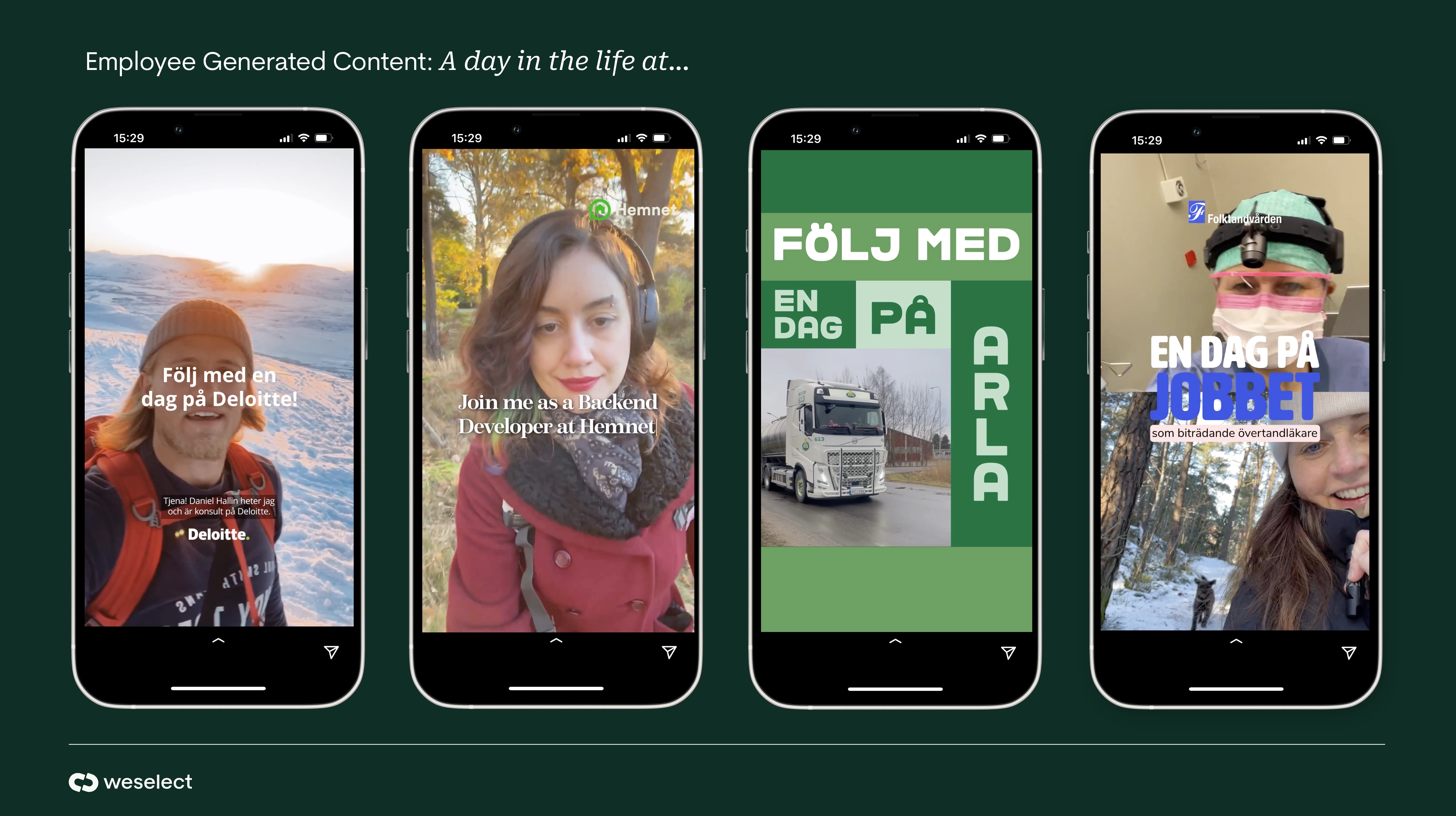
- Day-in-the-life videos in short-form (60–90 seconds, vertical)
- Role explainers, where an engineer, designer, or salesperson explains what they actually do
- Career stories showing how someone has developed internally over two or five years
- Office and team culture B-roll, combined with the employee’s own voiceover
- Subject matter expertise on LinkedIn, where employees share knowledge from their area of expertise
The common thread across all five is that the content is specific, personal, and useful. A generic “I love my team” post is unlikely to have much impact on applications. A senior backend engineer explaining how their team handles incident reviews can give a potential candidate a much more concrete picture of both the role and the workplace.
How can weselect help you get started with EGC?
Launching an EGC program doesn’t have to mean building everything from scratch. At weselect, we help employers turn their employees into authentic voices for the company and make sure that content reaches the right candidates.
- Find the right employee ambassadors: The best EGC starts with the right people. We help you identify employees who can represent the roles, teams, and parts of your culture you want candidates to see. This could be people who are already active on social media, or employees who simply have a story worth sharing.
- Define what you want to communicate: Not every employee needs to talk about the same things. We help you identify the topics and stories that support your Employer Brand and connect to the roles you are looking to recruit. The goal is to make content feel natural to the employee while still supporting your recruitment goals.
- Turn employee stories into content: From day-in-the-life videos and employee interviews to expert content and career stories, we help turn real employee experiences into content candidates actually want to see. The employee remains the voice, we help with the format, production, and creative direction.
- Get more from every piece of content: One employee story can have a much longer life than a single social post. We help you adapt and distribute EGC across your social channels, paid campaigns, recruitment communication, and other relevant touchpoints in the candidate journey.
- Reach the right candidates: Great content only works if the right people see it. By combining EGC with targeted social media advertising, we can help put authentic employee stories in front of the candidates you want to reach – rather than relying solely on organic reach.
- Measure the impact: EGC should be more than a brand awareness exercise. We help connect your content and campaigns to the metrics that matter, from reach and engagement to applications and recruitment outcomes. This makes it easier to understand what works and where to invest next.
The result? You get authentic content created by the people who know your company best – supported by a strategy that helps turn employee stories into Employer Marketing that reaches and engages the right candidates.
Want to explore EGC for your Employer Brand? Let’s chat about how weselect can help you get started today!
How do you measure EGC performance?
What are the biggest risks of EGC, and how do you manage them?
- Compliance and confidentiality: Manage this with clear written guidelines, a simple list of what employees can and cannot publish, and a fast channel for getting help with content they are unsure about.
- Key-person dependency: If one creator is responsible for 60% of your reach, the program can quickly lose momentum if that person leaves. Mitigate this by rotating cohorts every two to three quarters and building a broader pool of potential creators.
- Inauthentic content: When EGC starts sounding like traditional corporate communication, much of its credibility disappears. Edit for clarity, not perfection, and avoid controlling every sentence. The role of the brand team is to give creators the right conditions to succeed not to rewrite their voices.
How does EGC influence AI answer engines and search?
This is an area many Employer Branding teams are missing in 2026. ChatGPT, Perplexity, Claude, Google AI Overviews, and Gemini are increasingly answering questions such as “what is it like to work at Company X?” or “is Company X a good place to be a senior engineer?”
These answers are built by combining and synthesising publicly available content, where recent, specific, employee-driven perspectives can contribute a more concrete picture of what it is actually like to work at a company.
EGC can therefore become part of the content that informs these answers. Traditional careers pages play a different role: they are controlled by the company and often use a more marketing-led tone. A program that publishes 30–50 employee posts per quarter across LinkedIn, YouTube, and TikTok creates more content and more perspectives around what it is actually like to work at the company.
That is the strategic argument for EGC in 2026: it is an Employer Brand format that can contribute to human research, social discovery, and AI-driven search at the same time.
Ready to get started with EGC?
Your employees already have stories worth telling. The question is how to turn those stories into Employer Marketing that reaches the right candidates.
Want to explore what an EGC program could look like for your company? Book a meeting with us and let’s talk about your goals, your Employer Brand, and how weselect can help you get started.
FAQ
What does EGC stand for?
EGC stands for Employee Generated Content. It refers to content created by employees about their work or expertise. The content can be published on their personal channels or on company channels under their name.
Is EGC the same as employee advocacy?
No. Employee advocacy usually means employees sharing pre-approved corporate content. EGC means the employee creates original content in their own voice. Advocacy is distribution. EGC is creation.
How many employee creators do I need to start an EGC program?
Start with 3-5 people. That is enough to test different formats and measure results while keeping the group small enough to work with closely. Once the program has demonstrated clear recruitment outcomes, you can scale to more employees, or rotate to highligt new roles and departments.
How long does it take for EGC to produce recruitment results?
Well-run programs can generate measurable application results within one to two quarters, while the impact on Employer Brand and awareness often takes longer and may become visible after two to four quarters.
How can weselect help you get started with EGC?
weselect helps companies plan, produce, and distribute Employee Generated Content end to end. As an Employer Marketing agency, weselect runs the parts most in-house teams don't have capacity for: setup, editing, and distribution.
A weselect EGC engagement covers four things:
- Program setup. weselect's project managers build the strategy with you, using a day in the life guide that walks each employee through what to film and how, before the first video is shot.
- Employee filming guides. Clear, simple guides that let employees record good footage on their own phones, without needing a production team on site.
- Editing. A dedicated motion team edits raw employee footage into finished, on-brand formats.
- Distribution. A campaign team gets each piece of content in front of the right audience segment, across paid social, recruiter outreach, and your careers site.
Want to start an EGC initiative? Get in touch with weselect.
Do you need to pay employees to create EGC?
Many Nordic today companies use a combination of dedicated work time, internal recognition, and budgets for equipment and training rather than paying per post.
Is EGC GDPR-safe?
EGC can be GDPR-compliant when colleagues, candidates, and clients featured in the content have provided documented consent and employees follow clear guidelines on what they can and cannot share.
Can EGC be used in paid Employer Branding campaigns?
Absolutely! EGC works particularly well in paid advertising and can give campaigns a more authentic and personal feel. Employee-generated content can be used in paid social, recruitment communications, and other parts of the candidate journey.
What is the single biggest mistake in EGC programs?
Over-editing. When EGC starts sounding like traditional corporate communication, much of what makes the format credible disappears. The role of the brand team is to create the right conditions for employees to create not to rewrite their voices.